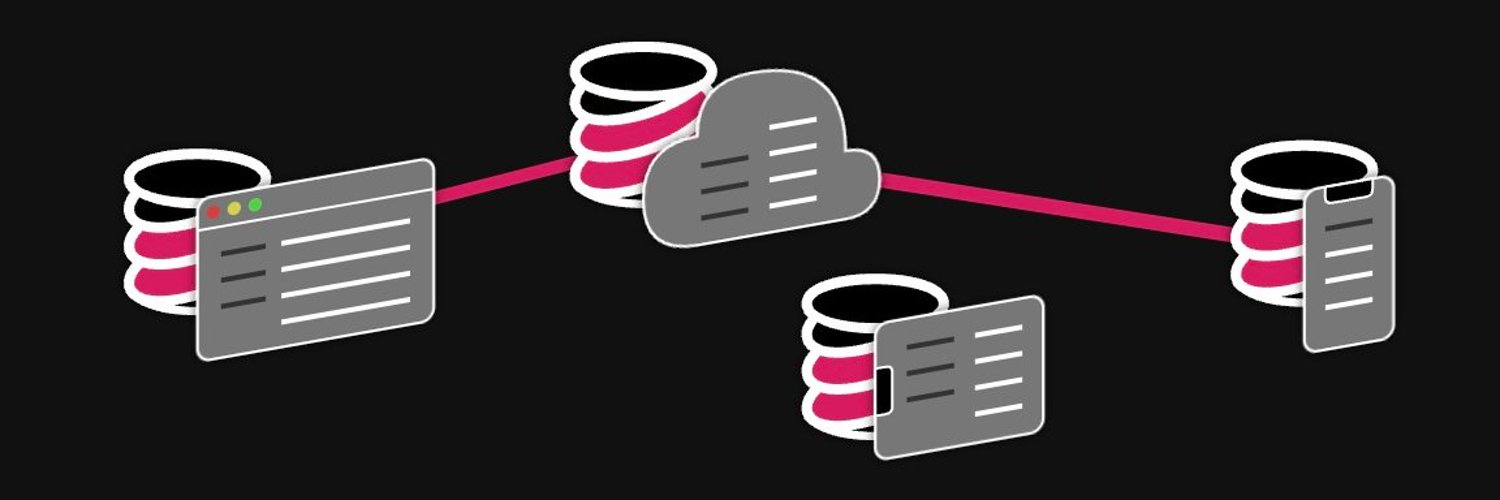

A reactive data store & sync engine.
In your JavaScript app.
- Tweets 583
- Following 3,204
- Followers 3,973
- Likes 364









...aaand the release notes and docs are up on the beta TinyBase site:
beta.tinybase.org/guides/rel…
2
456
Vite template with persistence is github.com/tinyplex/vite-tin… - should be self-explanatory!
1
2
531
OK, give the next beta a try please!
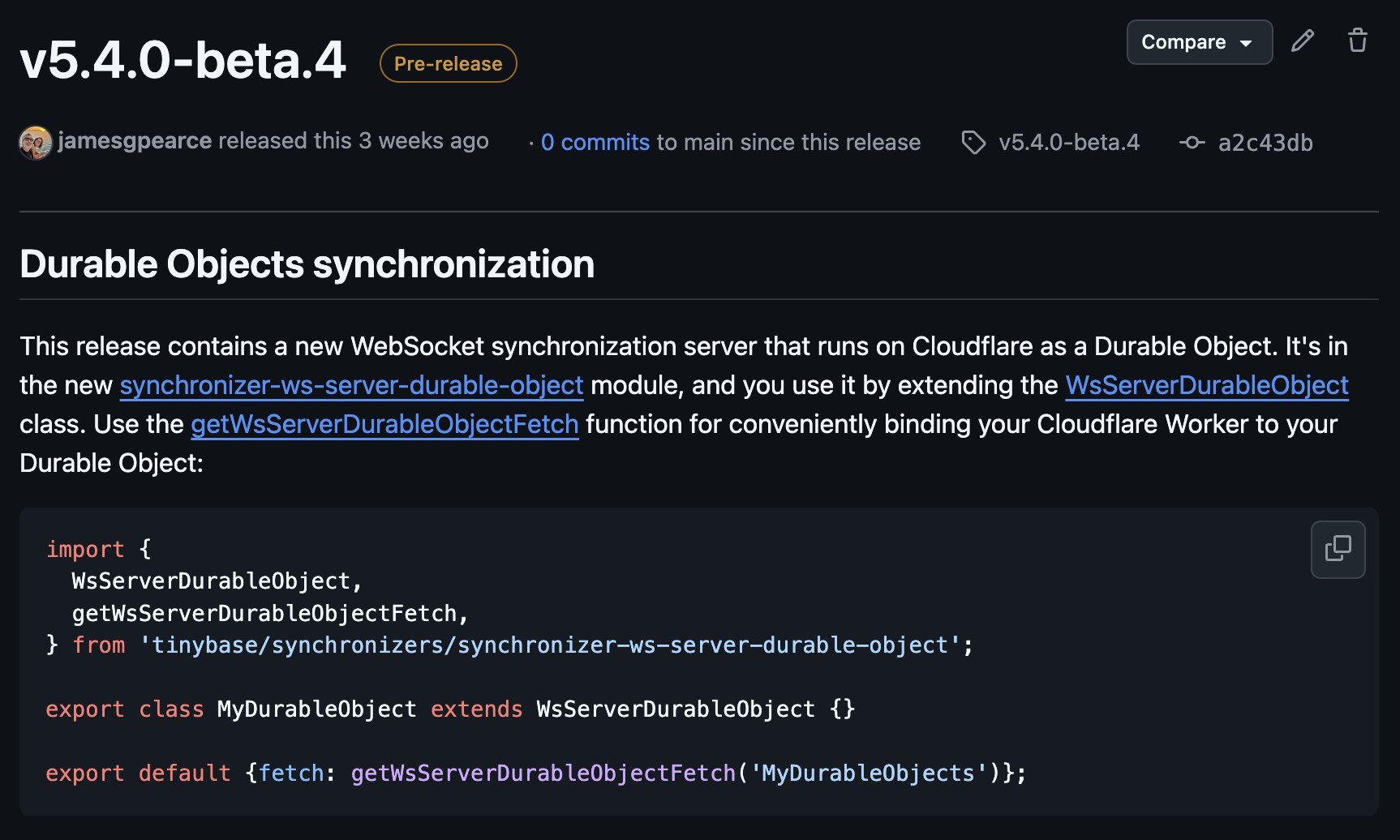
This has @Cloudflare Durable Objects synchronization _and_ persistence - and a Vite template (linked in the GitHub release notes) for getting up and running quickly.
Let us know. Fingers crossed, this will be the release candidate!
2
7
61
4,615
We think you're going to like the new @Cloudflare integration.
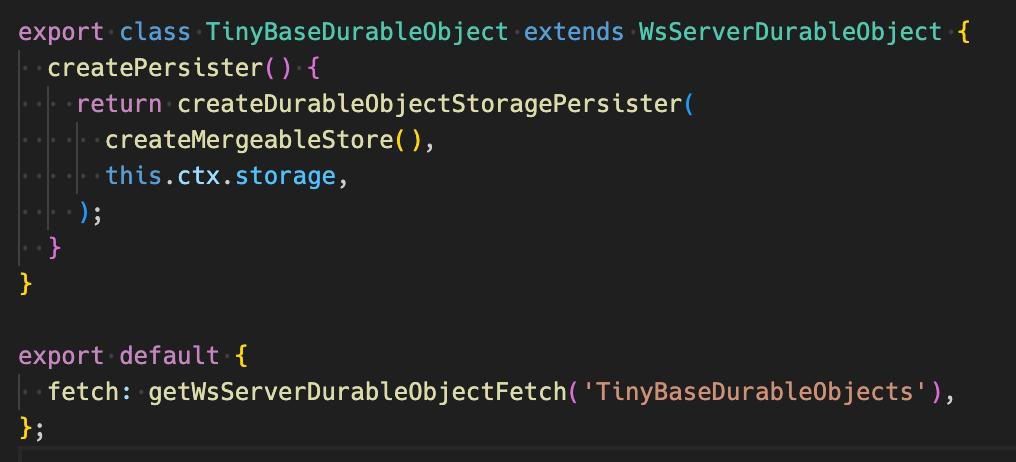
Fully synced real-time clients, with Durable Objects as a server source of truth?
This is the entire server code:
6
9
131
9,475
We’re over on the other place too!
All announcements will be cross-posted but please come hang out 💙
1
4
1,140
TinyBase retweeted
🎉 Some fun for the weekend!
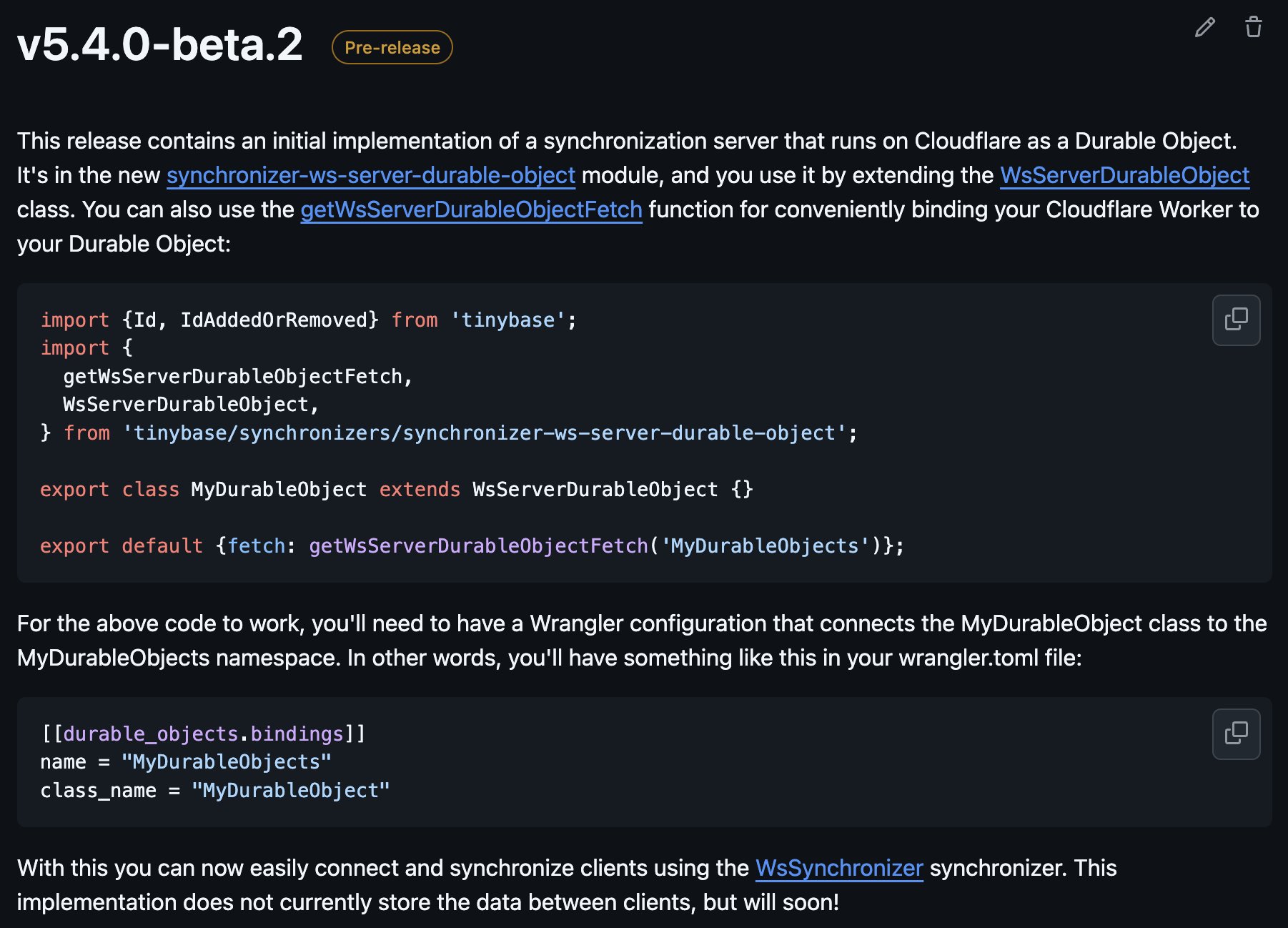
TinyBase v5.4.0-beta.2 incudes our initial support for synchronization via @cloudflare Durable Objects.
Stores sync between clients but do not yet, er, endure. Yeah, yeah... server persistence is in the next beta. 😎
Link to Vite template below! 👇
1
5
53
2,994
Try the Vite template at github.com/tinyplex/vite-tin…
We've also put up a demo server, so it takes literally 15 seconds to get this running, even if you are not a Cloudflare user (yet!).
Enjoy, and please provide feedback! 🙏
2
484
TinyBase retweeted

📍 @tinybasejs was built for local first apps.
Start building local-first apps and enable data synchronization with other devices and users with TinyBase 🤝 Expo.
expo.dev/blog/how-to-synchro…
2
8
67
5,451
How about we make it so TinyBase clients can synchronize with @Cloudflare DurableObjects?
88%
Yes
12%
Yes
132 votes • Final results
4
1
13
2,938
TinyBase v5.4.0-beta.1
This release includes a simple server implementation called WsServerSimple. Without the complications of listeners, persistence, or statistics, this is suitable to be used as a reference for other server environments.
Enjoy!
github.com/tinyplex/tinybase…
1
22
1,011
Should TinyBase be 𝘮𝘰𝘳𝘦 opinionated about persistent data storage? E.g:
a) tightly bind the existing API to one client-side SQLite solution
b) a vertical out-of-the-box integration with one cloud/sync provider
c) continue with our unopinionated integrations
All 3? 🤣
6
12
2,317
TinyBase retweeted

4/8 In my migration, I decided to use the @tinybasejs library for a reactive local database. This allows me to sync data across devices effectively while using Svelte Stores. The integration was seamless! #TinyBase ⬇️
2
1
1
553
TinyBase v5.3.3 - just released - has some improvements to our @powersync_ implementation.
Give it a whirl and let us know how it goes!
1
20
1,036
Happy Monday! 🍉
Here’s a fun small project we dropped over the weekend.
Let’s go and build more local-first apps!

🎉 Announcing TinyWidgets!
A collection of tiny, reusable, UI components - wrapped in a helpful app layout with header, side bar, dark mode, and more, "from the people who brought you..." 😎
There's a link to the project and the Vite starter template in the replies. Have fun!
1
7
2,498
Defier of Categorization. 🫡

Ok the third dimension is sync engine vs syncing datastore.
A syncing datastore is a backend datastore (that also syncs). It takes the place of postgres/mysql/whatever in your stack, and also takes the place of APIs. They *are* the system of record.
A sync engine is only a data transport layer. It takes the place of GraphQL/REST APIs, but not the place of the database.
Examples of sync engines are powersync, electric, replicache, zero, yjs, automerge, jazz tools .... and I guess I might put @tinybasejs in this category too?
Examples of datastores are instant, triplit, convex, firebase, liveblocks ...
The difference here is ease of use vs flexibility. The syncing datastores are tightly integrated systems that generally are very easy (almost trivial) to setup. But the downside is that they are their own universes. Hard to integrate with the rest of the tools from the software world.
If your sync engine is backed by standard pg, then customers can use it alongside anything that talks to pg. They can easily swap you out for some other sync engine. They can also swap out pg and use a different database.
On the other hand, people are currently alpha testing zero and the biggest stumbling block they hit right away is just getting the connection to pg setup 🫠.
Tradeoffs.
1
908
