

🚀 Open-source Headless CMS 💜 Join the Strapi Community at strapi.link/discord 🤝 Need help? github.com/strapi/strapi/dis…
🌍 Worldwide
- Tweets 7,394
- Following 658
- Followers 21,691
- Likes 5,809











Next.js 16 route handlers make building APIs a breeze!
Create CSV exports, handle currency conversion, and manage redirects seamlessly 📄🔄 with clean, efficient backend logic for devs working with Strapi & Next.js
Get into the details 👇
strapi.link/49JFf4x

4
526
Building mobile apps used to mean double the work. Two platforms, two codebases, endless complexity.
With @reactnative, you build once and ship everywhere. @expo removes native tooling entirely — no Xcode, no Android Studio.
Pair it with @strapijs for APIs, auth, and content, and you’ve got a powerful stack for mobile and web.
🎙️ Live chat with @kadikraman (Engineering Manager, Expo)
📅 Wednesday, Jan 21
⏰ 8:00–9:00 AM PST
📍 Google Meet
We’ll cover Expo, React Native, Strapi — and what’s next at Expo 👀 luma.com/b29olgkg
2
15
1,189
Strapi retweeted

Hoy para festejar la adquisición de @astrodotbuild por parte de @Cloudflare.
A las 2 pm hora de Ciudad de México, se estará publicando la masterclass para construir un sitio web con Astro + @strapijs 🔥
No se lo pierdan 🥳
youtube.com/watch?v=lQdyfvXE…

1
12
1,109
Build apps for the agent-led web!
Users are ditching browsers for chat-driven interactions 🙌
Expose your app’s actions with a simple protocol. Keep UI engaging, and let agents do the talking 🗣️
Discover more insights from our chat with @kentcdodds ➡️ strapi.link/4sGn9ce

2
6
2,975
Our partner Smartshore is hosting an upcoming event on building modern, scalable content platforms, and we’re proud to support them.
They’ll dive into how engineering teams can move from monoliths to API-first architectures, unify product and content data, and accelerate delivery with modern JavaScript/TypeScript tooling.
strapi.link/4qhok0h
2
578
🎉 What a Year — Thank You, Strapi Community 🎉
2025 was a huge year for Strapi, and we couldn’t have done it without you.
⭐ 70K+ GitHub stars
🔁 30K+ commits
🔀 9.4K PRs merged
🏗️ Thousands of teams building with Strapi
🎂 And yes… Strapi turned 10!
From Strapi AI, Live Preview, Conditional Fields, new integrations, to the first in-person StrapiConf and a more accessible Strapi Cloud. The community shipped big!
And we’re just getting started.
🔮 2026 = Quality & UX first
Stronger foundations. Better DX & editing experience. Faster, more reliable Cloud. And continuous collaboration as a Strapi community.
Thank you for building with us. 💛
Str’happy New Year!
👉 Read more: strapi.link/4sB8iQx
1
1
4
443
Strapi retweeted

@strapijs
🚀 Building something cool for Strapi 5...
Social Media Manager - auto-publish your content to X, LinkedIn, Facebook & Instagram with one click.
📌 Select which collections trigger posts
🔒 AES-256 encrypted credentials
📊 Built-in analytics
Coming soon 👇 anavem.com/other/social-medi…
#Strapi #StrapiV5 #HeadlessCMS #SocialMediaAutomatio
1
6
10
609
Strapi retweeted

Bye 2025, Hello 2026. I have something to tell you.
@Atinux @tannerlinsley @kentcdodds @wesbos @stolinski
2
5
13
5,188
What a year 2025 has been for Strapi 🚀 Discover what's coming in 2026:

Bye 2025, Hello 2026. I have something to tell you.
@Atinux @tannerlinsley @kentcdodds @wesbos @stolinski
1
6
585
Strapi retweeted

Love how you can use multiple MCP's to create whole new workflows. In @claudeai, I have @Octolens MCP I have built + using @kapa_ai Strapi Docs MCP and @strapijs content MCP to make publishing easier. Here is a test flow.
Pardon the typos, I did not intend to use this as demo.
1
1
4
6,179
Strapi retweeted

Hi friends 👋 let’s talk about @postmarkapp, your email delivery buddy 📩🤝
If you’re building an app with things like email confirmation, password reset, login alerts, or other notifications, you’ll need a reliable email service.
I’ve used SendGrid, Resend, and others… which are great. But let me introduce Postmark, an excellent option ✅
Postmark gives you:
⏺️ Email API
⏺️ SMTP
⏺️ Transactional email
⏺️ Analytics
⏺️ Webhooks... and so on!
For the @strapijs community, I updated the Postmark integration page based on a request from @boriskamp. Big thanks to Boaz for flagging it 🙌
You can integrate Postmark with Strapi in 6 steps 🚀
👉 Full guide: strapi.io/integrations/postm…
👉 GitHub Repo: github.com/Theodore-Kelechuk…
Have you tried Postmark before? What do you think? 👇

2
3
718
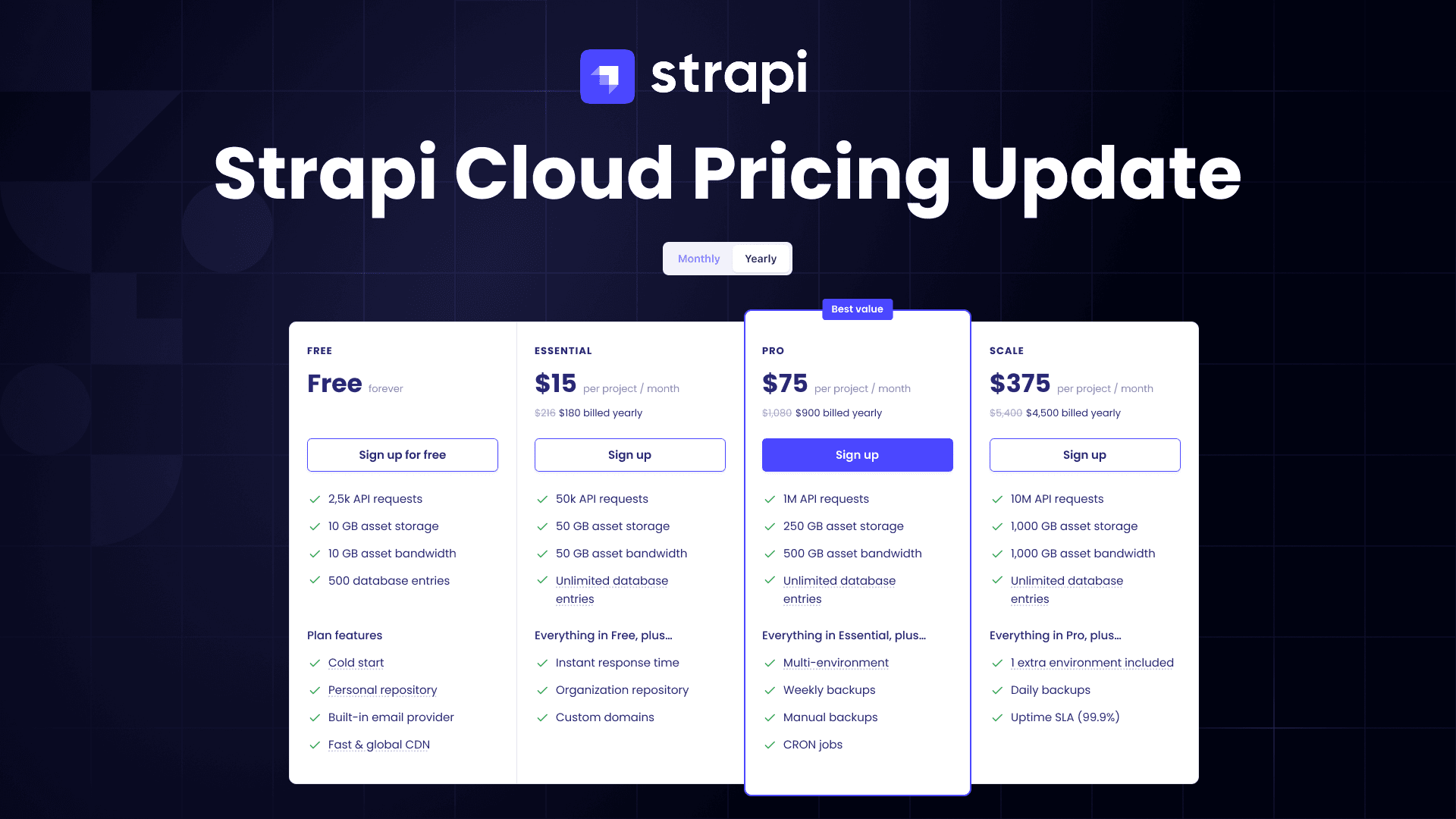
☁️ Introducing Yearly Plans and New Limits for Strapi Cloud 🔥
We lowered prices in March to reduce friction for builders.
Now, we’re taking the next step.
🎉 Yearly billing is here, with 20% savings!
The goal is simple: scale at your pace and pay only for what you need.
💰 20% off with annual billing
📆 One invoice instead of twelve
🔁 Monthly quota resets (API & bandwidth)
🧱 Plans designed to grow with your project
Free and Essential plans also get refined usage limits, while existing customers stay fully protected.
Less time managing infrastructure.
More time building products that matter. ✨
👉 Learn more: strapi.link/49fNmWu
3
848
Strapi retweeted

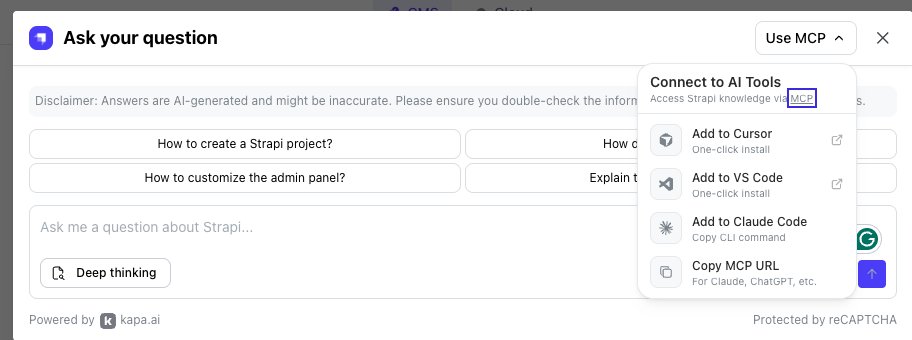
best thing i saw today
thnx to the gods of programmatic SEO for adding MCP to @strapijs CMS integration docs
1
2
523
Strapi retweeted
Huge thanks to @kentcdodds for sparking my interest in MCPs and his course 🙌 Just added MCP to a @strapijs plugin to track social mentions—making it easier to catch negative or constructive feedback and respond faster.
2
5
73
20,143
Strapi retweeted
It only took one chat with @kentcdodds, and now I am building MCP for my @strapijs app.
See the whole talk here 👉 strapi.link/48GLgjd
BTW, I am taking his excellent course on the topic 👉 epicai.pro
1
4
6
3,220
Create a custom API endpoint in Strapi in under a minute ⚡
Learn how to extend Strapi with your own endpoints—step by step.
👉 Full tutorial: strapi.link/49eIPV6
2
5
1,053
Strapi retweeted
The CMS is dead. Long live the CMS!
AI is changing the rules in every industry. The CMS is no exception, especially as it is at the intersection between developers and marketers, which are two of the most disrupted roles (code generation and content generation).
@leerob (VP of DevRel at @cursor_ai, ex-@vercel) published a great piece of content about their migration from a proprietary, restricted, Headless CMS to a fully Markdown file-based workflow.
And he is right (on some aspects): agents are excellent at editing both code and (content) files at the same time, as they can easily get both in context, especially in a great AI code editor like Cursor.
Markdown files are great for small projects. We’ve seen a lot of “git-based” CMS emerging over the past years. However, none of them has been successful for large-scale projects:
Requires a deployment every time there is an update
Data inconsistency
Unable to have relations between content types
Too technical for non-devs
But what we are talking about is worse than that. It is a no-CMS approach.
We’ve been there, done that: The first version of our own website was all about hard-coded content in a good old EJS template (yes, that was before React!) and a big JSON file containing all of the (5 or so) blog posts. We were 3 developers, editing files was easier and faster than setting up a CMS.
The Cursor team is very specific, as they are a team of engineers (which makes total sense for a code editor company).
It is great, until it is not. CMSs have been invented because non-technical people need to edit their websites without needing to reach developers.
CMSs bring the structure and features any serious project needs:
- Relations management
- Content internationalization
- Content scheduling (aka releases)
- Content history
- API tokens
- Webhooks
- Integrations
- Authentication
- Custom fields
- Media library
- Role management
- Review workflows
- Security (Single Sign-On, Audit Logs, etc.)
With all of this being said, I think the most important insight Lee shared in this post is the agentic approach to building content: everybody deserves to ask for website updates in plain English, and agents must be able to do this autonomously.
That means:
- CMSs must be agentic
- Agents must easily communicate with each other, or everything must sit under one single tool: frontend code, CMS, hosting, and more
This is exactly why:
- We launched Strapi AI
- We are about to release Strapi MCP
- TEAAAASING: Over the last eight months, we have developed a brand-new product that addresses all the issues mentioned above. Comment “FOMO” to get early access, and I will send you the link
Stay tuned!
24
8
82
12,763
🚀 Live session with Kent C. Dodds tomorrow!
🔧 Hosted by @strapijs
🎙 With @kentcdodds
🎟️ December 10th at 8am PST
Register here ➡️ strapi.link/4oE27rw
Chat is becoming the new UI. Join us for a live discussion on how LLM agents, chat interfaces, and the Model Context Protocol (MCP) are reshaping how people interact with the web.
2
2
7
3,989
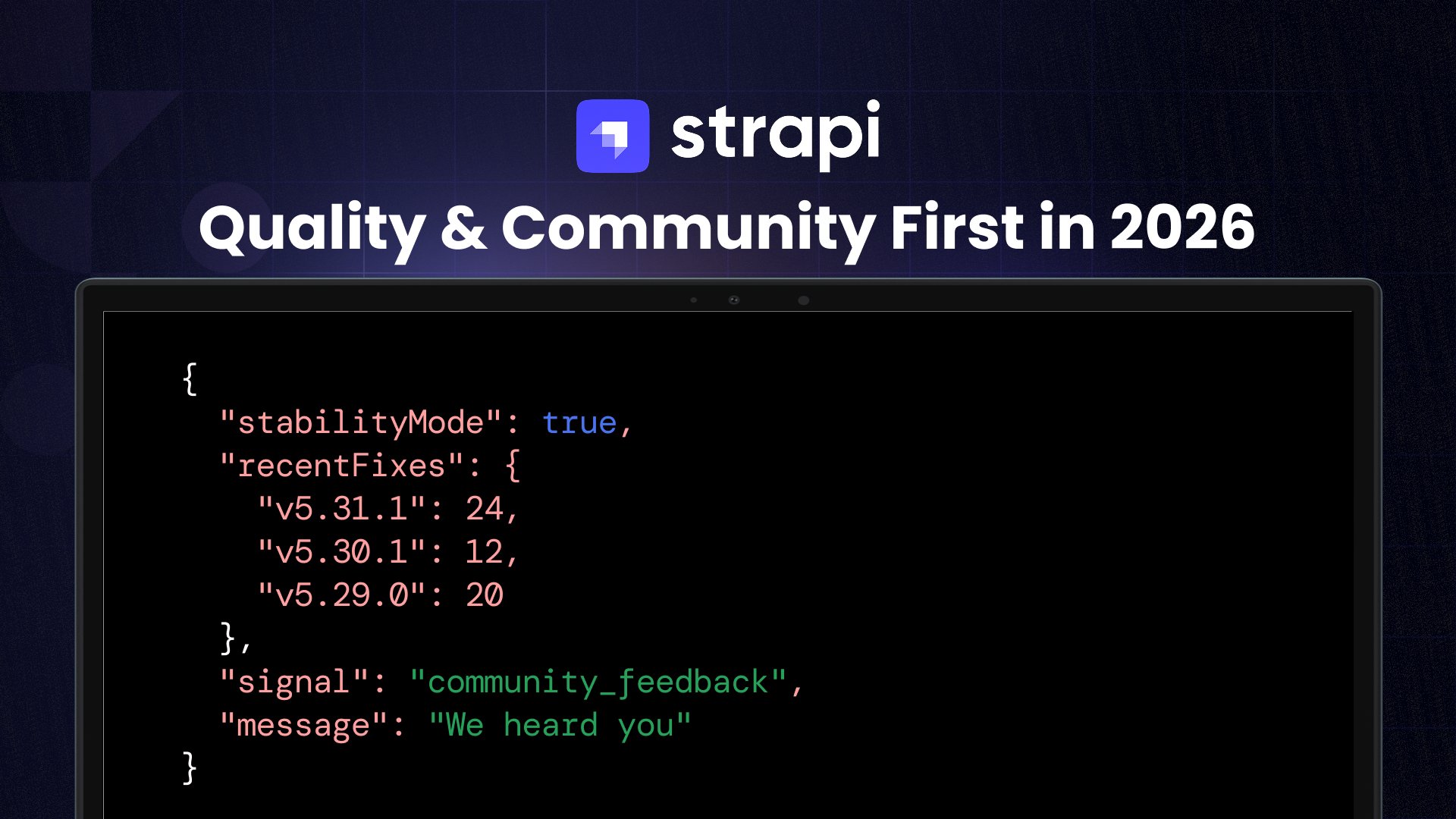
🔥 Quality-First Mode Activated🔥
You’ve seen the numbers:
v5.31.1 → 24 fixes
v5.30.1 → 12 fixes
v5.29.0 → 20 improvements
The message is simple: stability is our top priority for the rest of 2025 and all of 2026.
⚡ Faster, more reliable Media Library
🧱 Better bulk operations & relations
🔍 Smarter filters & search
🚀 Performance boosts across the board
And yes, your GitHub issues, feedback, and PRs are driving this shift.
Keep them coming. We’re listening. 💛
Learn more: strapi.link/3YbtVc2
1
4
15
1,477