

The React Framework – created and maintained by @vercel.
- Tweets 339
- Following 15
- Followers 287,632
- Likes 215














Next.js 15.5
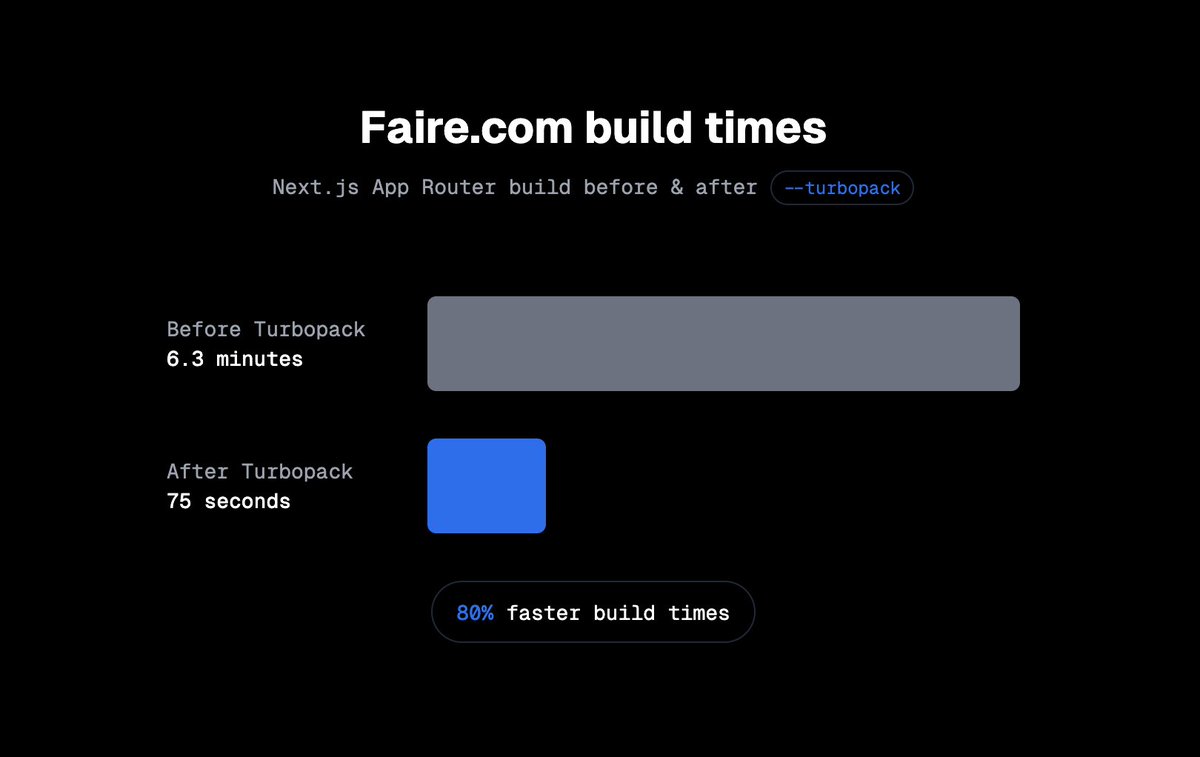
• Turbopack for builds (beta)
• Node.js middleware (stable)
• TypeScript support improvements
• `next lint` command deprecation
• Next.js 16 deprecation warnings
nextjs.org/blog/next-15-5
48
171
1,381
170,055
Next.js Conf returns to San Francisco this October and the call for proposals is now open.
Submit your talk ideas if you'd like to speak. Let us know what you'd like to hear about and who you'd like to hear from.
vercel.fyi/szCGZed
5
21
186
66,508
Next.js 15.4
• Turbopack Builds: 100% integration test compatibility for next build --turbopack
• General stability and performance improvements
• A preview of what's coming in Next 16
nextjs.org/blog/next-15-4
44
181
1,506
196,664
Get your certificate for completing our Next.js courses.
Learn about Next.js, React, SEO, and more in the future.
nextjs.org/learn

ALT Certificate for completing a Next.js Learn course
42
79
919
100,034

Congratulations to the winners of the Next.js Hackathon:
• Text0 (text0.dev)
• Work From Coffee OS (workfromcoffee.com)
• gitfaster (gitfaster.vercel.app)
Rewatch the awards stream to see live demos.
youtube.com/live/KDRwgbwq0_c
15
67
671
117,431
Next.js 15.3
• Turbopack for builds (alpha)
• Community support for Rspack (experimental)
• Client Instrumentation hook
• Navigation hooks
• TypeScript plugin improvements
nextjs.org/15-3
67
177
1,331
268,053
The Next.js hackathon starts tomorrow.
If you haven't yet registered, there's still time. Here's what you need to know.
Thank you to our 25+ partners for providing credits.

We're hosting our first Next.js global hackathon.
• 500 teams
• 10 days of hacking
• Credits from 25+ partners
Sign up today. Hackathon starts April 7th ↓
24
20
406
65,988
Update: even though the hackathon is full, if you are still interested, please join the waitlist. We're working on a solution.
Hacking begins in two days!
8
58
19,309
Next.js retweeted

Two things all fast websites have:
1. Fast initial page load
2. Fast transitions between pages
There's two concepts you need to understand for this:
1. Prerendering
2. Prefetching
I’ll briefly explain both and how Next.js handles them under the hood.
Prerendering
To have a consistently fast initial page load, ideally you do some work ahead of time. If you need to create the page from scratch on every request, it is more likely some users will have a slow experience.
Prerendering is where you take the inputs to your page (like a CMS or a database) and produce an output that can be cached. Data in, HTML out.
Critically, this work happens *before* the user makes a request. You might have heard this called SSG (Static Site Generation). You can prerender all of the pages for your site. Then, take the outputs and put them behind a CDN. Consistent, predictable, fast initial page loads.
But what happens when your content changes? For a simple website, you might just regenerate all of the pages again from scratch. For slightly larger websites, you can selectively update a *single page* in the background.
This is called ISR (Incremental Static Regeneration). But the acronym isn't the important part. It's still prerendering — it's just happening in the background.
Bonus: What if most of the page can be prerendered, but there's one section which shows content that is unique to the visitor? Can you combine prerendering *and* fresh user data? This is called PPR (Partial Prerendering), and is an experimental feature of Next.js.
Prefetching
Let's say you have a web application with 100 pages. When navigating between different pages, you want it to feel instant.
At some point, you need to load the data for the next page. There’s no getting around that. The question then becomes — when does the new page load?
You know how mobile apps can feel really fast moving between tabs? Well, that's because you had to watch the App Store loading spinner while downloading a gigantic blob of code to your phone. You paid the cost upfront.
Similarly on the web, you can pay the cost upfront. Bundle all of the code into a JavaScript file, and load it when you boot the app. This is the traditional SPA (Single-Page Application) approach.
Because you did the work ahead of time, subsequent navigations between pages are really fast. But, can we have both? Can we navigate quickly between pages *and* have a fast initial page load?
Next.js splits your application into smaller chunks of code, which load based on the page you are navigating to. Rather than downloading all the code at once, you load it incrementally.
Next.js also understands which pages you are likely going to navigate to, so it's able to *prefetch* the new page in the background. By the time you go to click the link, the new page has already been loaded. It's a magic trick.
You click and there's no browser loading spinner. Instead, the client quickly switches to the newly loaded page. This is nice because it scales as you add more pages in your application, without inversely affecting the initial page load time.
Next.js tries to do the right prefetching by default (more improvements coming here shortly...) and power users can tweak the knobs to do more/less prefetching based on their needs. You have the control between performance and resource consumption.
Summary
The web has many rendering acronyms to explain how pages can be created: SSR, CSR, SSG, ISR, PPR, and more.
But I've found it helpful to instead think about it as:
1. When is content being prerendered? Ahead of time? In the background? Or are we getting fresh data on every request?
2. When are we paying the cost to load the next page? Ahead of time? In the background? Or are we loading a new page from scratch on every request?
I'm still workshopping this framing, so open to feedback.
67
126
1,736
141,094
Thank you to our partners for providing credits:
Anthropic, Browserbase, Clerk, Convex, Cursor, Eleven Labs, Fal, Gemini, Groq, Langbase, Luma, Neon, OpenAI, Polar, Replicate, Resend, Scrapybara, Sentry, Supabase, Tinybird, Upstash, Windsurf, and xAI.
next-hackathon-2025.vercel.a…
8
15
232
30,453
We're hosting our first Next.js global hackathon.
• 500 teams
• 10 days of hacking
• Credits from 25+ partners
Sign up today. Hackathon starts April 7th ↓
88
110
1,486
347,328
RFC: Deployment Adapters API
We are planning to support adapters to deploy Next.js to any provider.
github.com/vercel/next.js/di…
28
69
746
106,042
Next.js retweeted

We've published our postmortem on Next.js CVE-2025-29927.
This includes the detailed timeline, analysis, and next steps for our LTS policy, new CVE process, and partner mailing list.
vercel.com/blog/postmortem-o…
11
42
319
85,271
Next.js 15.2.3 includes a security vulnerability patch.
We recommend updating to 15.2.3 or backported patches. If you cannot update, we have included guidance for how to protect your application.
Apps on Vercel, Netlify, and Cloudflare are not affected.
nextjs.org/blog/cve-2025-299…
42
247
1,614
699,954
Learn how to build APIs with Next.js.
nextjs.org/blog/building-api…
13
73
633
261,986
Next.js 15.2
• Redesigned Error UI & Improved Stack Traces
• Streaming Metadata
• Turbopack Performance Improvements
• View Transitions (experimental)
• Node.js Middleware (experimental)
nextjs.org/blog/next-15-2
77
239
1,915
434,157
Next.js retweeted

Fluid state transitions for the new, experimental Next.js Error Overlay
32
27
759
91,946
New open source template:
• Next.js
• Postgres
• Drizzle
• Stripe
• Tailwind CSS
• shadcn/ui
github.com/nextjs/saas-start…
84
395
4,065
336,437
New documentation: building Single-Page Applications with Next.js.
vercel.fyi/nextjs-spa
7
54
483
81,768