
Dreaming the future of software; Project Editor ECMAScript 2015; Reformed Smalltalker JavaScript historian dl.acm.org/doi/abs/10.114… @allenwb@mastodon.social
Sherwood Oregon USA
- Tweets 8,520
- Following 218
- Followers 6,374
- Likes 436


Interesting thread on how how our complex software systems can advance. Build new complex layers vs evolving existing layers.

Current Unix is a bottleneck, but people differ on how to react to that.
My take: "our field" grew from innovations of the form "built _a_ new system". We cling to that paradigm of innovation, even though it had stopped working in the late 1970s. 1/n
3
1
Allen Wirfs-Brock retweeted

If you're a prog language geek like me, this paper by @awbjs and @BrendanEich for #HOPL is **AMAZEBALLS**. The full JS history, insiders-style, chock-full of details and little-known facts and rationales, '95-'15. 126p, well worth the read! — zenodo.org/record/3710954
1
8
15
ECMA-262 Annex B is essentially things that must be legal in browsers (don’t break the web) but should be illegal elsewhere. The expectation was that non-web envs shouldn’t implement them. But most everybody uses web-focused JS engines with no way to disable Annex B features.
2
2
Allen Wirfs-Brock retweeted
As a high school senior I got to make a student presentation at the "Spring Joint Computing Conference". PL1/8 for the PDP-8.
The project was sort of dodgy but it was a great experience.
The Spring and Fall Joints were the 2 main massive computer industry trade shows.
1
1
3
One of the languages PL/I was intended to replace was COBOL. The other was FORTRAN. Neither worked out so well. Probably the first demonstration of how hard it is to displace an entrenched programming languages—even for new applications.

One of the design criteria for NPL. NPL was the “new programming language” designed by IBM for introduction with System/360. It was eventually named: PL/I.
From: IBM NPL Technical Report, Dec. 1964.
archive.org/details/bitsaver…

1
3
4
One of the design criteria for NPL. NPL was the “new programming language” designed by IBM for introduction with System/360. It was eventually named: PL/I.
From: IBM NPL Technical Report, Dec. 1964.
archive.org/details/bitsaver…
1
2
9
1965 PL/I Primer
it doesn’t even mention the really exciting “list processing” features: dynamically allocated records and “pointers”. There were separate manuals covering those that COBOL programmers could ignore.
archive.org/details/bitsaver…
1
2
Compiler geeks may find the 1966 “PL/I (F) Compiler Program Logic Manual” interesting. It described the internal design of the compiler. Note that the “F” means that the compiler was design to work in 64KB of “core”.
archive.org/details/bitsaver…
1
11
Allen Wirfs-Brock retweeted

My latest #ThinkDesignWorkSmart conversation has been full of insights and surprises for me. Thank you @awbjs for sharing stories and fundamental ideas about code design and programming language. Watch part 1 here: youtube.com/watch?v=faq-QIRg…
2
1
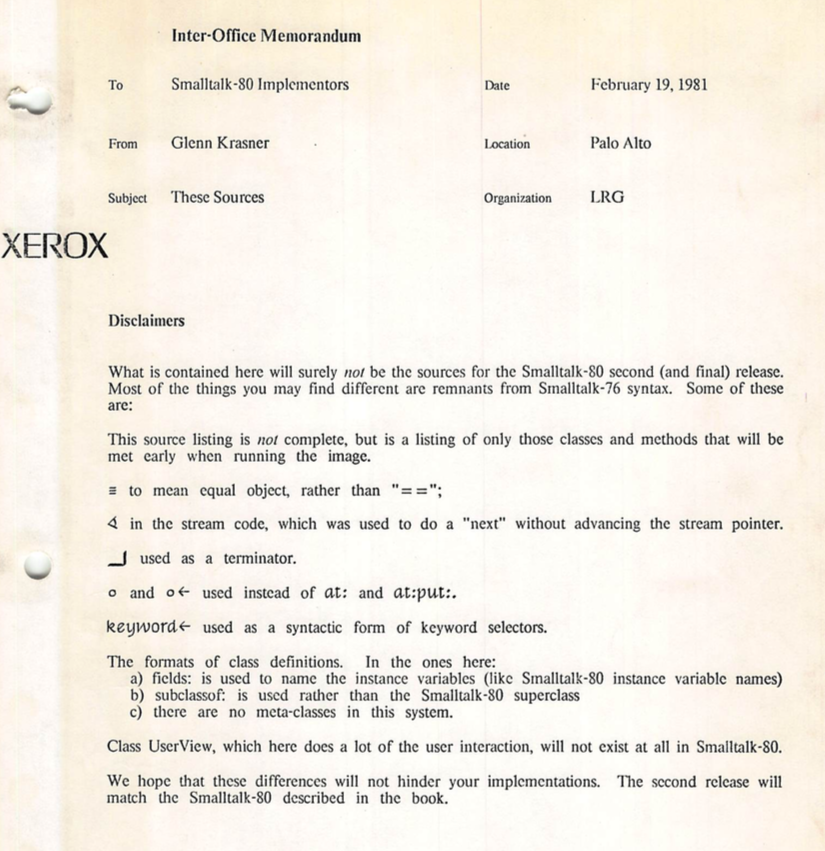
Another ancient Smalltalk artifact:
The 1st Smalltalk-80 image Xerox LRG distributed to its external implementer partners was mostly a Smalltalk-78 image. They provide us with a partial source code listing. Here it is: wirfs-brock.com/allen/files/… (18.6 MB)
2
12
26
From HOPL-I: "The Early History of COBOL" dl.acm.org/doi/abs/10.1145/8…
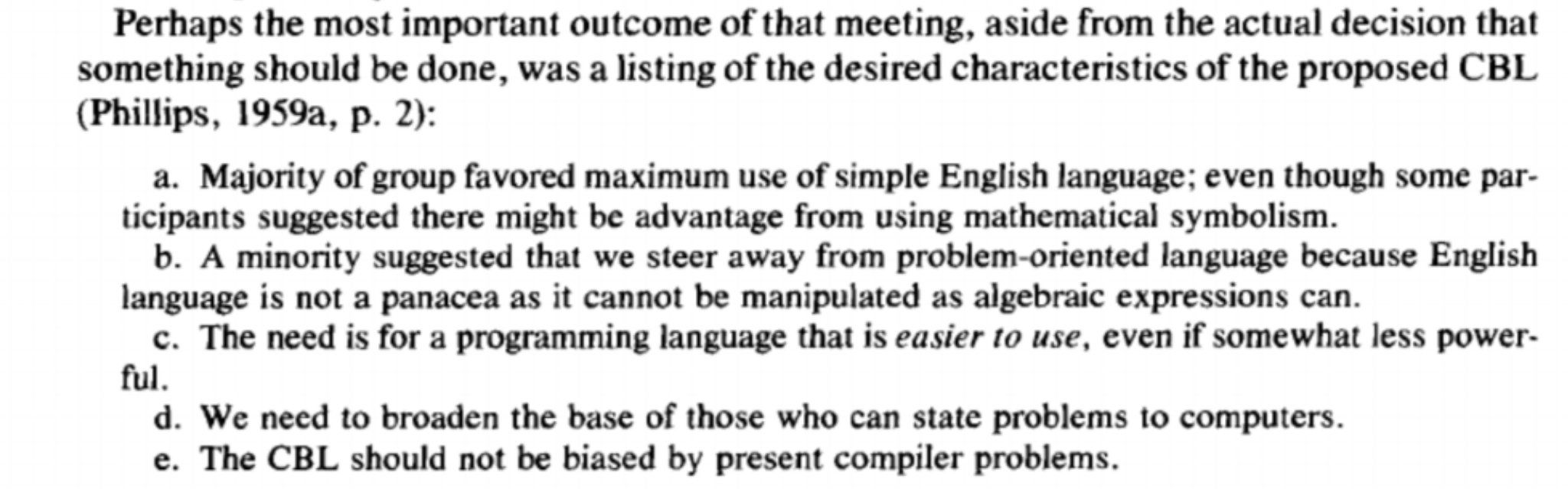

For real, it's like if BASIC and AppleScript were mashed together and then thickly frosted with bureaucracy buttercream.
1
7
Allen Wirfs-Brock retweeted

I've been pondering for a while now what literate programming means, or could mean, in the 2020s. My feeble effort in understanding this is at medium.com/@torazaburo/whith….
2
2
4
This is a great essay about what it takes to create what appears (I’ve only skimmed it) to be a great technical book.
It implicitly explains why “Literate Programming” never caught on for complex programs. It’s just too hard to do if your primary task is to ship software.

Friends! The last chapter of Crafting Interpreters is here: craftinginterpreters.com/opt…
Four years, 281 illustrations, and 260,085 words later and the book is complete. To thank you for your patience, here's a post about my experience writing it: journal.stuffwithstuff.com/2…
3
4
18
Considered and rejected for ES5. Best we could do was to make it readonly and add strict mode restrictions.
undefined as a global prop was not added until ES3 (1999). Much code before/after (slow browser turnover) locally defined:
var undefined;
1/
1
3
2/2
Many pages with such code are still accessible via archive.org and other archives. Also, old and interesting but unmaintained active sites.
“Don’t break the web” includes not breaking the web’s archived legacy.
4

Allen Wirfs-Brock retweeted

What’s that you’re hearing? Oh, that’s the sound of a volatile stock market.
Here's @jordanwb’s explanation of the work behind the sonification: mktplc.org/2WYWvik
4
8
A good source of info about the period of peak commercial Smalltalk development and use is the Smalltalk Report. It was the newsletter followed by insiders and enthusiasts:
1991-1995 issues: sdmeta.gforge.inria.fr/TheSm…
1996 issues:
macqueen.us/stIndex.html
3
9
24