
Dreaming the future of software; Project Editor ECMAScript 2015; Reformed Smalltalker JavaScript historian dl.acm.org/doi/abs/10.114… @allenwb@mastodon.social
Sherwood Oregon USA
- Tweets 8,520
- Following 218
- Followers 6,373
- Likes 436










Allen Wirfs-Brock retweeted

Almost better: “automated refactoring is impossible without static types”
Smalltalkers: invent first automated refactoring tool, Refactoring Browser
2
14
49
The problem with distributed teams and how to do it right. Read to the end for the solution

Did you see my interview with Bjorn Freeman-Benson on the three challenges of distributed teams? jamesshore.com/Blog/Three-Ch…
1
Sigh, you mean we could have had iotatrons instead of transistors? It would have been a different world.
12
25
The Xerox Star used a AMD2900-based buit slice processor rather than a off-the-self single chip microprocessor. That was state of the art design for late 1970s. The Wikipedia Star article includes a good history of the Star hardware en.wikipedia.org/wiki/Xerox_…

Architecturally, the Star was a minicomputer. This is the CPU of the Xerox Star. It took many chips to perform the functions that one chip handled on the Apple II, Lisa, and Macintosh. engblg.livingcomputers.org/i…

6
19
Allen Wirfs-Brock retweeted

In hindsight, it may have been better to always:
ESM = import
CJS = require
Also easier to refactor.

Great reply
I think the confusion that keeps coming up is that Babel has an interopRequireDefault transform that makes default esm exports work as if they are cjs module.exports
I think this was a p big mistake because now people understandably think esm should work that way
1
1
12
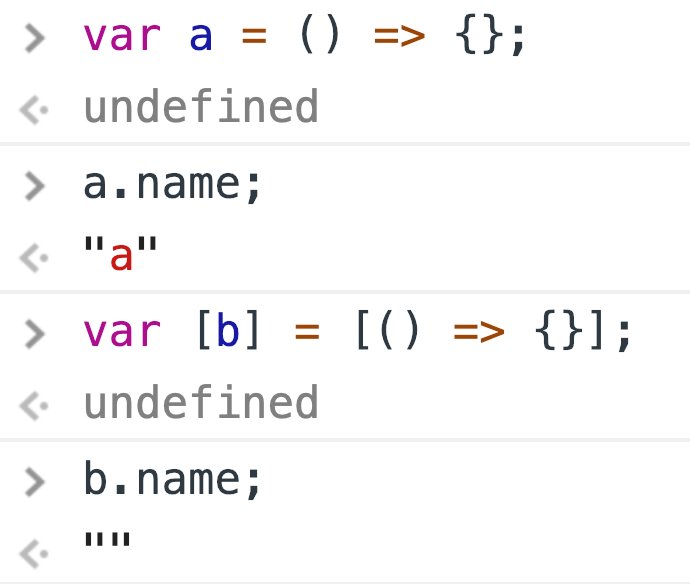
Assigning names to anonymous functions definitions is syntax driven. See for example 2nd to last rule of tc39.github.io/ecma262/#sec-…
It literally is looking to see if the thing to the right of the = is a lambda def rather than looking for a function value.
1/

1
2
8
When destructuring of a literal is involved, the targeted of the assignment (or binding) is syntactically remote from the source of the value with arbitrarily complex destructuring patterns and literals.
Difficult to specify how to match them to check for a literal lambda
2/
1
1
Not specific to Typed Arrays. Rather can occur on any property set operation that transforms the stored value. EG:
let obj = {
_val: 0,
get p() {return _val},
set p(v) {_val = v*10}
};
console.log(++obj.p, " ", obj.p);

Ouch:
> const arr = Uint8Array.of(255);
> const x = ++arr[0];
> arr[0]
0
> x
256
Why? Chris Wellons explains: nullprogram.com/blog/2019/01…
7
23
👍 But in 2.3 handleClick should really be a data prop, not a method. The class, not the client, should be responsible for binding this.
So, code as:
get handleClick() {return
()=>{console.log("Clicked:" +
this.name)
}
}
Yes, extracting methods is indeed a pitfall. My way of making sense of `this`: 2ality.com/2017/12/alternate…
3
4
I had hoped I would get through life without every having to learn LaTeX.
Unfortunately, I didn’t make it.
3
1
13
Recently saw a tweet. Paraphrased: “I want decorators so build tools can use them”. Which of course dynamic decorators don’t really support.
When did TC39 last consider use case trade-offs between annotations (static metadata) and decorators.
nicholasjohnson.com/blog/ann…

Sounds like we’re in agreement! Built-in decorators ftw.
I want decorators to happen, and I think limiting the feature to built-in decorators is the way we’ll get there. We can always add more built-in ones over time.
1
5
Isn’t a “built-in decorator” just new language syntax that begins with a @keyword?
How would the process for adding a new built-in decorator to the language be any different from the process for adding any other new syntactic extension?
I’d love to see us investigate built-in decorators more deeply. If the JS engine knows the exact behavior, we can optimize for it. The current proposal’s unlimited flexibility, where a decorator runs arbitrary user code, is what kills optimizations.
5
3

JavaScript's success is as a "worse is better" (look it up) language. Adding many new features to improve it may actually be detrimental to its continued success. What it needs is slow addition of carefully considered features that enable key new use cases.
8
66
248
"Classes" are best used for modeling (understanding and implementing) the division of labor (responsibilities) among the entities within a complex application
wirfs-brock.com/PDFs/013-015…
wirfs-brock.com/Resources.ht…

My rule of thumb is to only make it a class when there's going to be more than one instance.
... or when I need to provide one for a framework.
1
10